
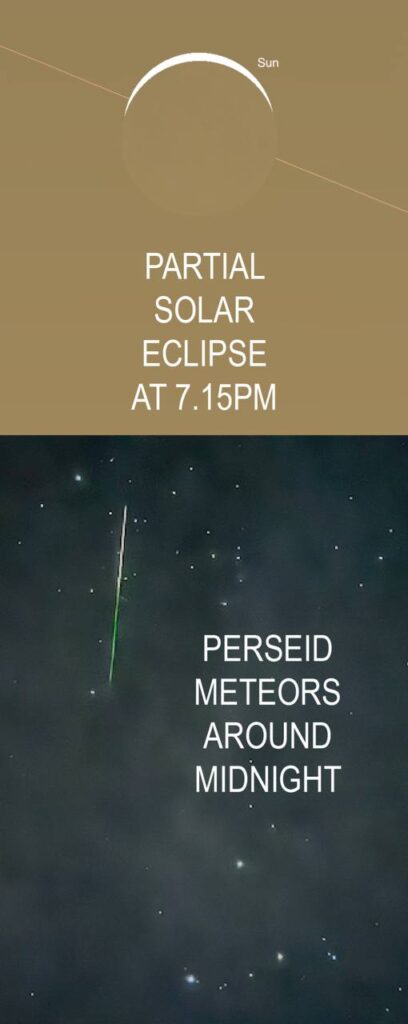
Hopefully, the 12th of August is cloud free as we have two spectacular sky events. See our post below.
The first event starts when the Sun is beginning to set in the western sky. At 6.18pm the Moon will start to gradually move in front of the Sun and continues until at 7.15pm when it covers 95% with just a small 5% sliver of Sun shining through as a crescent at the top. WARNING: NEVER look at the Sun with the naked eye or through scopes, even when a small bit of the Sun is still appearing. Always use eclipse glasses or view it projected onto a surface. Projecting the Sun through a cooking colander will show multiple little crescents which is fun. The Moon continues to drift out of the way and at 8.09pm it finally clears the Sun. This is a Partial Solar Eclipse. To see the Sun totally blocked out in a Total Solar Eclipse is an eerie but spectacular experience where you can safely look with your eyes and see the Sun’s atmosphere and various pink prominences around the jet black silhouette of the Moon. This intermittent astronomical event begins in the north in Russia then Greenland then Iceland. Then it tracks right across the northern Atlantic through northern Spain and finally Mallorca and into the Mediterranean. I hope to view it from the Spanish east coast which will be my fourth Total Eclipse. It can be very addictive!
A few hours later on the 12th August, in a dark sky site look up around midnight until 5.30am next morning to see multiple “shooting stars”. Meteors can happen at any time when annually around 40,000 tons of random space dust drifts into our atmosphere and burn up. But August has the best meteor show of the year with particles the size of dust or small pebbles creating spectacular streaks of light that seem to eminate in the north-eastern sky that has the constellation Perseus. This is the Perseid Meteor Shower which begins on 14 July and ends on 24 August but peaks on 12 August with possibly 150 bright meteors per hour streaking across the sky. This happens the same time every year as the Earth, on its orbit around the Sun, drifts through the dust remnant from Comet 109P Swift-Tuttle. In 1862 Lewis Swift and Horace Tuttle independently discovered this comet which takes 133 years to orbit the Sun once and will return again in 2125. At 16 miles across Swift-Tuttle is a large comet. As it gets close to the Sun, it heats up and pieces break off. The debris ends up in the Earth’s path around the Sun and can slam into our atmosphere at speeds of 36 miles per second. The air in front of the meteor is squashed and heated to thousands of degrees Celsius and the smaller meteors vaporise and leave behind a bright trail of light but larger meteors can explode as fireballs. WOW!
Glynn Bennallick